
Overview: Background Verification in India
Background verification (BGV) in India has evolved from a routine HR checkbox exercise into a critical function for building trust, managing risk, and strengthening workplace security. Growing automation across key checks is accelerating this shift, enabling faster verification and reducing reliance on manual processes.
Driven by a massive corporate workforce and the rapid expansion of remote work, employers must balance robust risk mitigation with swift onboarding speeds.
Historically, verifying a candidate's background required weeks of physical paperwork, manual site visits, and slow postal outreach to universities. Today, India is home to one of the world's most advanced public utility data frameworks. By transitioning to a digital-first model, companies can leverage government-backed APIs and central repositories to instantly validate identity, employment, and academic credentials.
This guide outlines the core legal standards, crucial intake fields, and the top digital verification channels required to build a compliant screening ecosystem in India.
Compliance & Legal Framework
Every background verification program in India must align with national digital privacy laws to avoid severe regulatory data liability.
| LAW / STANDARD | REQUIREMENT |
|---|---|
| DPDPA 2023 | Candidate consent is a strict legal mandate. Clear, explicit consent must be secured prior to initiating any screening. |
| ID Retention | National ID cards (Aadhaar, PAN) must only be used for portal cross-referencing. They cannot be stored or retained by employers post-verification. |
| IT Act 2000 | Organizations are legally required to maintain data security practices to protect sensitive personal and financial data during transmission. |
| Contract Act 1872 | Consent forms must be standalone and easy to read. They cannot be hidden within a standard employment contract. |
Critical Operational Challenges & Nuances
The Challenge of Identical Names
India features a high density of common names and identical surnames. Name duplication frequently triggers false positives across criminal registries. To resolve identity matches accurately, capturing the applicant's Father's Name is essential.
Critical Intake Form Fields
To avoid severe processing delays or immediate check rejections, candidate intake forms must treat the following three fields as strictly mandatory:
| FIELD | REQUIRED FOR |
|---|---|
| Father's Namex | Criminal Court, Financial Sanctions, Bankruptcy, Open Media, and Directorship screenings, to rule out false matches. |
| Employee ID | Required by Indian corporate HR systems to process Employment Verifications. |
| University Registration / Seat Number | Required by educational boards to process Academic Verifications. |
Non-Digitized & Legacy Academic Records
While newer academic records are rapidly being synced to DigiLocker and the National Academic Depository (NAD), millions of graduates from state universities, older colleges, and autonomous institutions hold legacy paper records. Many state-run universities still rely on manual ledger books stored in physical record rooms.
| FIELD / DOCUMENT | REQUIRED FOR |
| Physical Degree Certificate / Passing Certificate | Manual physical verification against legacy university logbooks and physical ledger entries. |
| Final Year Mark Sheet | Cross-referencing roll numbers and graduation years to locate manual records in university administrative offices. |
| University Demand Draft (DD) / Fee Receipt | Processing physical verification fees directly at state-run university banking windows. |
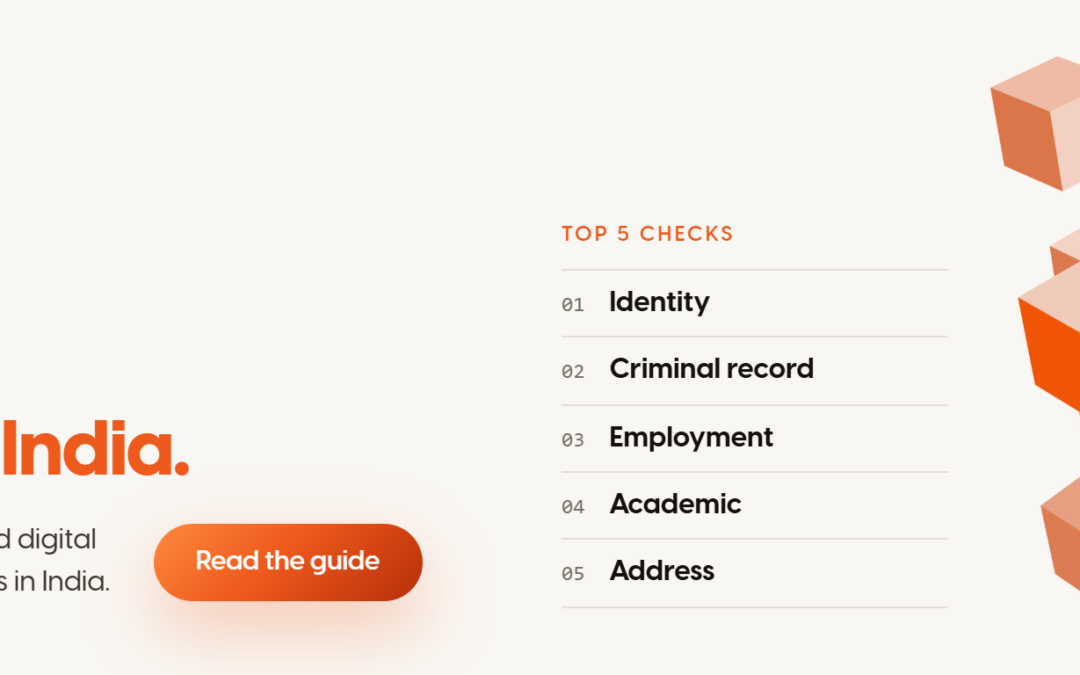
Top 5 pre-employment checks
| S.No. | Pre-Employment Check | Digitally Available Verifications | Integrations Available |
| 1 | Identity Verification (IDV) | Real-time API checks against central government databases | Direct validation with Aadhaar (UIDAI), PAN Card, Voter ID (ECI), and Passport registries. Fully supports DigiLocker integration for secure, candidate-authorized instant document retrieval. |
| 2 | Criminal Record Check | Online automated searches across digitized court records. | Direct API connectivity with the National Judicial Data Grid (NJDG) and the e-Courts services portal for real-time litigation tracking. |
| 3 | Employment Verification | Digital history checks that cross-reference corporate retirement fund contributions. | Direct integration with the Employees' Provident Fund Organisation (EPFO) portal to instantly pull and verify multi-year employment histories via Universal Account Number (UAN) tracking. |
| 4 | Academic Verification | Electronic records matching across major university boards and central repositories. | Automated screening through the National Academic Depository (NAD) and DigiLocker ecosystems for immediate verification of digital certificates and mark sheets. |
| 5 | Address Verification | Instant digital validation using public utility database records. | Automated cross-referencing via government infrastructure APIs, including Electricity Board databases, LPG connection registries, and Telecom subscriber records. |


